Decision Support, Not Information Overload
Why More Screens Rarely Produce Better Command Decisions

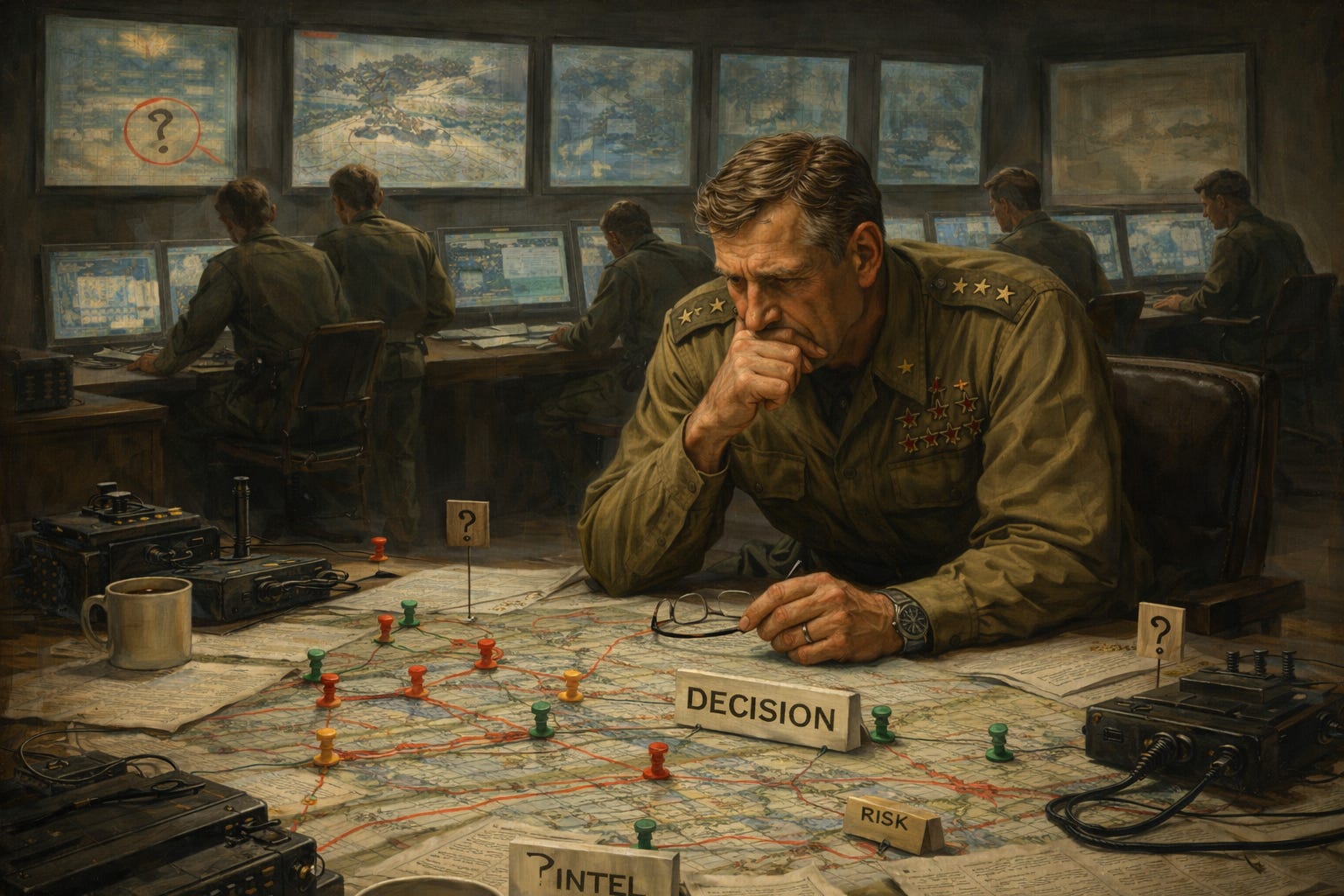
Vignette
The TOC looked impressive.
Twelve mission monitors wrapped the room, flanking two large projector screens. Live drone feeds. The air tasking order. Blue force tracking. Airspace control measures. Logistics dashboards. Battle rhythm slides. A scrolling news feed.
The Director worked hard to keep information flowing so the J3 could see every update as it happened. Each workstation glowed with multiple monitors.
But a simple question lingered: how many people in this room were supporting the commander’s next decision, and how many were simply watching the war unfold?
This should have been designed from the beginning. Making war easier for the commander is always the objective.
Decision Support Exists for Decisions, Not Awareness
The Fog of War, attributed to Clausewitz*, describes the uncertainty commanders face when information is incomplete, delayed, misleading, or wrong. Sometimes the fog is real. More often, it is created by our own processes and the natural confusion of the battlefield.
Decision support exists to enable decisions, not awareness for its own sake.
Before discussing products, staffs must understand the purpose of planning and what they control during execution. All of it exists to help the commander make the right decision at the right time despite friction, confusion, and uncertainty.
Assets allocated to decision support should not be diverted to satisfy curiosity or enhance general awareness. A staff can be perfectly informed and still fail its commander. It happens when nobody asked the right question.
What Makes a Decision a Decision
A decision is not an update, an assessment, or a discussion. It is a deliberate choice built into the plan that only the commander can make.
Effective decisions share common characteristics. They:
Are tied to a specific binary action
Are linked to operational objectives
Are bound by time and space
Must be made by the commander
If no real choice exists, there is no decision. If collection is allocated where no choice can be made, that effort is wasted.
Staffs must separate what they want to know from what the commander must know to decide. The Joint Force rarely lacks collection capability. It lacks discipline.
Decision Points Are Conditions, Not Calendar Events
Decision points exist to present the commander with a clear choice at the latest possible moment that still allows execution.
They are condition based, not schedule driven.
Conditions may involve enemy actions, friendly posture, environmental effects, or the operational situation. When properly designed, a decision point produces a simple yes or no choice supported by observable indicators that can be collected and reported in time.
Typical examples include committing a reserve, opening or closing ports, breaching or bypassing obstacles, shifting phases, exploiting success, or consolidating gains.
Decision Support Is Validated During Wargaming
Before building a collection plan, the staff must know which decisions the commander is expected to make and when.
During wargaming, decision points must be tested as rigorously as maneuver and fires. Indicators must be observable. Collection must be feasible. Reporting timelines must support execution.
Every valid friendly course of action must defeat all enemy courses of action. Even then, commanders will require flexibility to adjust timing, resources, and tempo as the enemy reveals itself. Early decisions are often driven by what becomes clear first.
Decision support tools do not create decisions. They discipline the staff around supporting them.
Tools Serve the Decision, Not the Staff
Decision support templates, matrices, collection plans, and CCIRs exist to synchronize staff effort around the commander’s next decision.
They are not intelligence products. They are not briefing aids. They are coordination mechanisms.
While intelligence functions often manage these tools, decision support is a staff responsibility. Every section contributes. During execution, the staff’s job is to narrow complexity, eliminate distraction, and focus relentlessly on what the commander must decide next.
Plans will drift. Friction is inevitable. Some decisions cannot be predicted.
A good staff minimizes surprise through disciplined planning and wargaming, not performative displays of information. When the unexpected occurs, the commander should have space to think, not be buried in data.
Decision support exists to make command possible in war’s chaos. When it does anything else, it has failed.
Decision support is not about seeing more. It is about enabling the right choice at the right time. When staffs organize planning, collection, and reporting around decisions instead of awareness, they preserve command judgment rather than consume it. In war, clarity comes from focus, not information.
*This was always going to happen at some point. I make no apologies.